


Page 127 - 4096-BOOK2
P. 127
125
In the previously mentioned book, Gamble and Wilson, based on
information from Conor Fitzgerald, note that the American Sterling Co.
of Hartford, Connecticut, manufactured an alloy similar to German-silver
rather than sterling silver, and “The Colt company experimented with the
new metal, which had the advantage of an appearance like sterling silver,
but of a strength comparable to steel.” The book also points to “The Science
Record for 1873: A Compendium of Scientific Progress and Discovery
During the Past Year with Illustrations” from 1873 which indicates the
new alloy they produced was invented by Helen L. Macker and the new
“American Sterling Metal” was being tried for various products, including
the important details: “Its strength is so great that it can be, and has been,
substituted for steel in the manufacture of pistol-barrels, while repeated
tests, made at the Colt Armory, at Hartford, Conn., show that it has three
times the tenacity of the latter metal. At an experimental trial, a spring
of steel wire parted at 3000 pulls: 82,000 pulls were necessary to break a
precisely similar wire of sterling.”
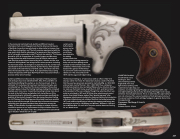
Gamble and Wilson note that only four examples of Sterling marked
Colt derringers have been identified: 3635, 3642, 6415, and 3847, not
specifically identifying this example as one that was known. Only an
estimated 100 are believed to have been manufactured, maybe even
considerably less. The majority of the known examples of these alloy
derringers appear to bear the Sterling markings, making this unmarked
example even more scarce. It would be interesting to know more about
the tests at the Colt factory and whether Colt started them or if the
American Sterling Co. initiated the experiments, perhaps specifically for
publicity of their metal’s strength. These few known American Sterling
Co. Colt “National Arms” Derringers would certainly have been excellent
ways to show off the strength of the new alloy to interested customers,
especially given that many would not have known how anemic the
stubby .41 Short Rimfire cartridges were. Macker, a resident of Boston,
received her patent on her “Improvement in Alloys to Imitate Silver” on
January 23, 1872. The patent notes “This compound will not tarnish with
age or weather” which this now roughly
century and a
half old pistol
proves, and an
alloy like this
would have
been desirable
for making
pocket pistols since
they are prone to being exposed to
heavy use and silver plating would
naturally tarnish and flake under such
conditions. Unfortunately, none of the
details of the genesis of this limited
run are known at this time beyond the
reference in “The Science Record for
1873” and the vague Colt ledger listing.
The American Sterling Co. of Connecticut (with an office in New York
City) was rather short lived. The Glastonbury factory outside of Hartford
that they used was previously operated by Curtisville Mfg. Co. 1854-1865
and was taken over by Thomas J. Vail c. 1865-1869. These companies
manufactured German silver and plated flatware there. American Sterling
Co. took over from Vail’s trustee Leavitt Hunt in 1871, and Hunt is listed
as the president of the new company. Though they advertised their new
metal as not plated in 1872 and 1873, their later advertisements noted
electro silver plated flatware made of their “greatly improved” alloy.
Newspaper advertisements indicate the American Sterling Co.’s production
at factory at Glastonbury, just outside of Hartford, had ended around late
1877, and additional publications indicate the company and factory was
purchased at auction by J.B. Williams and William S. Williams in 1878 and
ran as Williams Bros. Co. until 1950. They also used the American Sterling
Co. as a brand name.
CONDITION: Excellent,
the extremely scarce
Sterling Co. silver
alloy remaining entirely
bright with some very
light surface spotting, some
scattered very light dings and
scratches, and crisp engraving. The grips are also excellent with a few
very light handling marks and crisp checkering. The trigger reset is weak,
otherwise mechanically functions. This is an extremely rare opportunity to
own not only one of the scarcest variations of Colt derringers, but one of
the scarcest variations of Colt cartridge handguns in general. Do not miss
this opportunity!
Provenance: The George S. Lewis Jr.
Collection.
Estimate: 20,000 - 35,000


