


Page 166 - 4096-BOOK2
P. 166
164
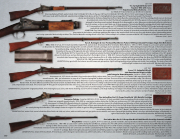
LOT 1169
Fine Indian Wars Era U.S. Sharps New Model 1863 Metallic Cartridge Conversion Saddle
Ring Carbine - Serial no. C,22273, 50-70 U.S. Govt cal., 22 inch round bbl., blue/casehardened finish, walnut stock. This Sharps was originally
manufactured c. 1863-1865 as a percussion carbine during the Civil War era, and was one of 31,098 carbines returned by the U.S. Government to Sharps Rifle Manufacturing Co.
starting in 1867, who received a contract for refurbishment and alteration of their guns for use with metallic cartridges, per page 200 of “Flayderman’s Guide”. Many of these were
immediately sent back out into the field where they saw continued use with the cavalry during the Indian Wars. This example retains its original .52 caliber six-groove rifling, intended for use with
the .50-70 cartridge. Blade front sight and Lawrence patent notch/folding ladder rear sight. “DFC” (David F. Clark) ribbon cartouche on the left center of the buttstock.
CONDITION: Fine, retains 40% blue finish, 30% vivid case colors strongest in protected areas, with brown patina on the balance and oxidation. Wood is very good, with handling marks and nicks, a spot of filler on
bottom of forearm, and a defined cartouche. Mechanically excellent.
Estimate: 1,800 - 2,750
LOT 1168
Fine Indian Wars Era U.S. Sharps New Model 1859 Metallic Cartridge
Conversion Carbine - Serial no. 64214, 50-70 U.S. Govt cal., 22 inch round bbl., blue/casehardened finish, walnut stock. This
Sharps was originally manufactured c. 1859-1863 as a percussion carbine during the Civil War era, and was one of 31,098 carbines returned by the
U.S. Government to Sharps Rifle Manufacturing Co. starting in 1867, who received a contract for refurbishment and alteration of their guns for use with
metallic cartridges, per page 200 of “Flayderman’s Guide”. Many of these were immediately sent back out into the field where they saw continued use with
the cavalry during the Indian Wars. This example retains its original .52 caliber six-groove rifling, intended for use with the .50-70 cartridge. Blade front sight and Lawrence patent
notch/folding ladder rear sight. “DFC” (David F. Clark) ribbon cartouche on the left center of the buttstock.
CONDITION: Fine, retains 50% arsenal refurbished blue finish and vivid case colors, with smooth brown and gray patina on the balance and some scattered light freckling. Wood is also fine, with defined edges, a filled patch on
right of the forearm, light scratches, and a defined cartouche. Mechanically excellent.
Estimate: 2,000 - 3,000
LOT 1167
Scarce U.S. Springfield Model
1880 Experimental Trapdoor Rifle
with Triangular Ramrod Bayonet - Serial no. 156761, 45-70
Government cal., 32 5/8 inch round bbl., blue/casehardened finish, walnut stock. This is one of a reported 1,014 Model 1880 experimental rifles
manufactured c. 1881, per information on page 81 of “Trapdoor Springfield” by Waite and Ernst. There are far less surviving examples today. This rifle was
the first serious attempt at adopting the ramrod bayonet by the U.S. military, which was received negatively, as were almost all attempts that followed all the way up to the early
Model 1903s. The main difference between this model and the standard Model 1879 rifles is the inclusion of a sliding “rod bayonet” with a triangular blade, the associated locking mechanism fitted below the barrel,
and compartment in the butt. Two circled script “P” firing proofs stamped behind the lower tang, and Samuel W. Porter’s boxed script “SWP/1881” inspection cartouche stamped on the left stock flat. Includes a dog tag marked
for a Private John E. Farrell of Company F 49th U.S. Infantry Volunteers Black Regiment. Includes a period leather sling (portion absent).
CONDITION: Fine, retains 60% original blue finish, 70% vivid original case colors, with brown freckling and some minor oxidation, and sharp markings and edges in the metal overall. Stock is very fine, with distinct edges, light dents
and scratches, and a crisp cartouche and proof stamps. Mechanically excellent.
Estimate: 2,500 - 4,000
LOT 1166
Rare E. Remington & Sons Produced Ward-Burton Pattern 1868 Experimental Prototype Single Shot Bolt Action
Rifle - NSN, 45 CF cal., 30 1/4 inch round bbl., bright finish, walnut stock. Developed by New York native Bethel Burton c. 1850s to 1860s, initially as a percussion system patented
on December 20, 1859, before being re-designed for use with centerfire metallic cartridges and re-patented on August 12, 1868, utilizing interrupted threads on the bolt and receiver
for positive locking. Called the Ward-Burton after Col. William Ward was added to the patent by Burton in 1969, the Ward-Burton bolt action rifles and carbines were
innovative in the eyes of foreign and domestic military observers, with the design subsequently produced in small numbers by the U.S. Springfield Armory c. 1870-
1871 as the Model 1871 for troop trial use. This example pre-dates the latter Springfield Armory versions, lacking the standard armory markings or the 1871 patent
date on the bolt cover, and was likely produced by E. Remington & Sons. c. 1868-1870. Features fixed front and Remington pattern folding leaf rear sights, a right side
mounted saber bayonet lug on the barrel, a barrel chambered for a .45 caliber bottleneck cartridge with six groove rifling, the three-line “BURTONS-PAT/DEC.20th
1859/AUG.12th 1868” patent marking on top of the bolt cover, and no other visible markings other than “U.S.” on the reused buttplate.
CONDITION: Very good, with the balance smooth brown and grey patinas, light freckling/spotting, minor pitting, and mostly clear markings. The stock is fine with
scattered light compression marks and scuffs. Mechanically functions.
Estimate: 3,000 - 4,500
LOT 1165
U.S. Springfield Model 1873
Trapdoor Rifle with Scarce
Experimental Metcalfe Device - Serial
no. 61828, 45-70 Government cal., 32 5/8 inch round bbl.,
blue/casehardened finish, walnut stock. Only 100 Model 1870 rifles in the year 1873 and 1,008 Model 1873 rifles (60000-74000 serial range) in the year
1876 were made with the Metcalfe experimental cartridge block device at the U.S. Springfield Armory, per page 589 of “Flayderman’s Guide”. The Metcalfe
device was invented by Ordnance Department officer Henry Metcalfe and patented in 1875. The cartridge blocks were to be issued
pre-loaded and carried on the belt. The Metcalfe equipped Model 1873 rifles appear to have never been issued and are
assumed to have been nearly entirely disposed of via disassembly or sales. Many were reattached to rifles by collectors in
the 20th century, as this is most likely one of these examples. The included Metcalfe cartridge block holds eight rounds of
.45-70 ammunition. Federal eagle and “U.S./SPRINGFIELD/1873” marked lock, “MODEL/1873/(eagle head and arrows)/US”
marked high arch breech block, and long wrist stock with an oval bordered script “ESA” cartouche on the left wrist.
CONDITION: Fine, retains 30% original blue finish, 50% original oil-quenched casehardened finish, with smooth brown and
gray patina on the balance, and sharp markings and edges in the metal overall. Stock is very fine, with distinct edges, light handling marks,
and a crisp cartouche. Mechanically excellent. The restored Metcalfe cartridge block is fine. This is a fine example of a seldom encountered Model 1873 Trapdoor rifle with the Metcalfe device!
Estimate: 4,000 - 6,000


