


Page 280 - 4096-BOOK2
P. 280
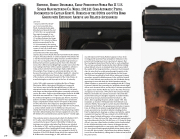
LOT 1305
- Serial no. S800079, 45 ACP
cal., 5 inch round bbl., blue
finish, checkered plastic grips.
Manufactured towards the end
of 1941, this is an exceptionally
fine original example of one
of the most sought after of all
U.S. military firearms, the Singer
Model 1911A1. Only 500 of these
pistols were produced for the
U.S. Government by the sewing
machine company throughout the
course of 1941, all of which were
shipped to the U.S. Government
around the time of the devastating
surprise attack on the Pacific Fleet at Pearl Harbor by the Empire
of Japan. This attack thrust an under-prepared United States into
a war that had already been raging in Europe and the Pacific for
years. The vast majority of these high quality Singer pistols are
believed to have been quickly issued to men in the Army Air
Corps, who suffered astoundingly high casualty rates early in the
war, leading to far fewer of these pistols available to collectors
today, and an extreme few remaining in high condition like
this example. These Singers are extremely desirable, not only
because they represent one of the highest quality U.S. sidearms
ever produced, but because they are also a tangible symbol
of the resilience and unwavering spirit of the United States, its
manufacturing base, and its people in the face of adversity.
In late 1939, eight companies including the likes of Singer,
Winchester, Marlin, Harrington & Richardson, Savage, and
Iver Johnson were invited by Springfield Armory to bid on
educational orders for production of the Model 1911A1 pistol,
with Singer and Harrington & Richardson eventually selected to
receive the orders. Singer received Educational Order No. W-ORD-
396 which was awarded on 17 April 1940. The pistols were to
be produced alongside a set of gauges, jigs, fixtures, machines,
patterns and other equipment necessary for mass production.
Singer completed the initial order for 500 pistols in December
of 1941, which were then shipped to Springfield Armory for
distribution. Singer was awarded a larger order for 15,000 pistols,
a contract which would never be fulfilled as it became clear
shortly after that their specific talents of manufacturing could be
far better utilized making more intricate equipment such as the
M5 Artillery Fire Control Directors and the Sperry T-1 bomb sight.
This particular pistol is documented to Kurt Otto Rubisch (1917-
2011), who carried it during his time in the Army Air Corps
serving in the European Theater in World War II. Rubisch was
training as an aviation cadet when Pearl Harbor was attacked
in December of 1941, and he eventually received qualifications
as an armament officer, handling both bomb ordnance and
other aircraft armament. Initially he was assigned to the 441st
Squadron of the 320th Bomb Group, which was equipped with
B-26 Marauders. Interestingly, in 1942, while the unit
was still stationed in Florida, Rubisch appears to have been
investigated for potential “Nazi sympathies”, likely due to his
parents both having been born in Germany. It appears that
the investigation determined that he had no such sympathies.
The unit was eventually transported by ship to Britain initially,
where Rubisch notes in an included letter that he was told of
the quality of the Singer pistols by a colonel on their transport
ship. He notes that he recalls going through the pistols in his
squadron and exchanging his issued sidearm for this Singer.
The 320th was transferred to North Africa, taking part in many
operations around the Mediterranean, Sicily, and Italy. Around
June of 1943, Rubisch was transferred to the 97th Bomb Group,
appearing to serve with both the 340th Squadron and the
342nd Squadron, a group which was equipped with B-17 Flying
Fortresses. Rubisch was eventually also qualified as bomb sight
officer and a chemical officer, and by July of 1944 was promoted
to captain. Kurt’s brother Martin was also in the Army Air Corps
and appears to have been a P-47 pilot in the European Theater.
Rubisch survived the war and was married in 1953, with him
and his wife having one daughter together. Included with the
pistol is the previously mentioned letter from Kurt to a Mr.
John L. Moss regarding the pistol, which is dated 1969. Also
included is an October 1943 dated letter from Rubisch to an
unknown “Bertha” discussing his current situation while likely
stationed in North Africa. The grouping also includes a treasure
trove of official documentation regarding Rubisch’s military
career, personal notes, two photo albums including photos
from his deployments, dog tags, a compass and whistle, a pilots
navigation kit bag, two VHS tapes related to the 320th Bomb
Group, a bag of related military pins, a few campaign medals/
awards, a U.S. Army Air Corps “Ike” type jacket with captain’s pins
and a shoulder patch for the 15th Air Force, a U.S. Army Air Corps
officer’s visor cap, a Boyd leather shoulder holster hand marked
for the 97th Bomb Group, and a German SA dagger that was
presumably brought back as a war trophy. Also includes copies
of a short, partial autobiography by Rubisch that details some of
his early life. Also includes a signed letter from Michael Hawkey
(son-in-law of Kurt Rubisch), stating that his father-in-law had left
the pistol to him.
Historic, Highly Desirable, Early Production World War II U.S.
Singer Manufacturing Co. Model 1911A1 Semi-Automatic Pistol
Documented to Captain Kurt O. Rubisch of the 320th and 97th Bomb
Groups with Extensive Archive and Related Accessories
278


