


Page 318 - 4096-BOOK2
P. 318
LOT 1356
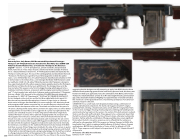
Extremely Rare, Only Known, Well-Documented Experimental Prototype
Thompson .30-06 Squad Automatic Selective Fire Auto-Rifle, Class III/NFA C&R
Fully Transferable Machine Gun, as Featured in “Thompson: The American
Legend” - Serial no. 11, 30-06 Springfield cal., 23 inch round bbl., blue/parkerized
finish, walnut stock. A very unique weapon, and the only known example of its kind:
this is a delayed blowback selective fire .30-06 rifle patterned after and inspired by the
Thompson submachine gun. This exact rifle is photographed and described in the book
“Thompson: The American Legend” by Tracie Hill on page 240, in which the author
states, “...one-off, World War II era .30-caliber Thompson Autorifle, built sometime in 1943
to demonstrate to the military how a current design (the Model 1928 Thompson) could
be modified to .30M2 [.30-06] caliber.” While the inventor John Thompson is known to
have experimented with rifle-caliber weapons, known examples (such as the Thompson
Autorifle) do not follow the format seen with this arm. The strongest clues as to the
how and why of this weapon come from the trigger housing, which appears to be a
traditional Colt/Auto-Ordnance component, with the original serial number removed
and “11” struck nearby (note: while Auto-Ordnance made a serial number 11 Thompson,
that was a Model 1919 observed in the collection of the NRA Museum), along with
the markings “C.J. WEST JR.”, “Experimental”, “12/43” and “H.P. UNGER JR./CHICAGO, IL”,
the last stamped on the stock iron and the first three added with electric pencil. C.J.
West has not been identified. Records place a Herman P. Unger Junior as a firearms
dealer active in Chicago after World War II, his career ending in 1972 after being found
with unregistered M2 carbine conversion kits. It is possible that one or both men were
involved with the development of this arm. The muzzle end of the barrel has part of a
“JA” above a flaming bomb stamp, with no provisions for sights, with a set of four drilled
and tapped holes on top of the receiver suggestive of a Lyman rear sight (absent). The
receiver, also unmarked, measures 17 inches long (about 4 full inches longer than a
standard Thompson receiver), with a right-side charging handle slot and ejector port.
The magazine well is two-piece construction, with a front bracket mounted to the
forearm iron and a rear bracket with spring loaded catch mounting to the rails on the
underside of the receiver, which accept a BAR magazine modified with a set of slots on
the sides to hold oiler pads(one magazine included, oiler pads not present). Internally,
the bolt bears a resemblance to the traditional Thompson bolt, but instead of the Blish
lock there are a pair of brass flange levers installed in the sides of the receiver, an ejector
claw actuated by the bolt, and a threaded recoil spring housing extension, and the bolt
is fitted with an internal firing pin and a spring-loaded plunger for the bolt face installed
in a flanged extension which, on final approach of the cartridge into the chamber
spreads outward to engage the rear of the barrel. The use of brass in the receiver flanges
suggesting that the designer was still attempting to apply John Blish’s theories about
dissimilar metals producing greater friction under heavy pressure loads; this theory was
found to not hold up in application, hence the elimination of the Blish Lock from later
Thompsons. Installed furniture consists of an M1-style straight forearm, grooved pistol
grip, and a detachable buttstock. Weighing in at approximately 17 pounds unloaded,
this steel beast is all but guaranteed to be a head-turning centerpiece of an advanced
automatic weapons collection.
CONDITION: Fine as a well made, well designed prototype using a combination of
existing and fabricated components. The barrel and magazine retain 80% original
parkerized finish, showing a mixed brown patina overall, with 80% original blue finish
on the receiver and trigger housing, showing edge wear, rubbing and handling marks
overall, and some heat spots on the receiver. One section of the bolt extension is absent.
Stock is very fine, with scuffs and dents. There appears to be a component absent from
the bolt to actuate the firing pin at the time of breech closure, otherwise mechanically
functions. Further, while the combination of flange assemblies does create significant
friction when the bolt is closed, no assurances can be offered that the resistance is
sufficient for safe operation. NOTE: This weapon is a National Firearms Act (NFA), fully
transferable Class 3, which is registered with the Bureau of Alcohol, Tobacco, Firearms
and Explosives, (BATFE) that is classified as a “Curios or Relic” as defined in 27 CFR,
478.11. These weapons are still subject to the provisions of 18 U.S.C. Chapter 44 and 27
CFR part 479.
Provenance: The Mike Free Collection.
Estimate: 75,000 - 130,000
316


