


Page 89 - 4096-BOOK2
P. 89
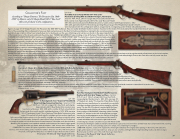
LOT 1082
Very Fine Remington New Model Pocket Percussion
Revolver with Iron Spur Trigger and Case - Serial no.
4776, 31 cal., 3 1/8 inch octagon bbl., blue/silver finish,
rosewood grips. Manufactured c. 1865-1873, per page 165
of “Flayderman’s Guide”. The majority of New Model Pocket
production was manufactured or converted to use metallic
cartridges, making original percussion examples relatively
scarce. The top flat of the barrel is marked with the three-
line Remington patent dates and address above lightly
factory stamped “NEW MODEL”. Matching visible assembly
number “13” marked on the left of the grip frame, trigger
housing lug, and handwritten on the interiors of the grips,
with serial number “4776” on the bottom of the barrel. It
is fitted with blade and frame notch sights and smooth
rosewood grips. Includes a hardwood case with fitted red felt
lined interior, Remington addressed double sided federal eagle and crossed revolvers powder flask, dual cavity bullet mold, cleaning
rod, primer tin, two 5-count cartridge packs (one empty, one containing 4 cartridges).
CONDITION: Very fine, retains 70% original blue finish, light oxidation, 60% original silver plating on the frame, with attractive
bright golden patina on the exposed brass. Grips are also very fine, with tight fitment, light handling marks, and distinct edges.
Mechanically excellent. Case is fine, with minor age related wear.
Provenance: The Howard “Skip” Quade Collection.
Estimate: 2,500 - 4,000
LOT 1079
Incredibly Scarce Sharps Model 1851 “Box Lock”
Percussion Sporting Rifle Inscribed to George L. Havemeyer -
Serial no. 1487, 44 cal., 28 inch octagon bbl., blue/casehardened/silver
finish, walnut stock. Approximately 1,857 of the early “Box Lock” Model
1851 rifles were manufactured by Robbins & Lawrence under contract with Sharps between c. 1852-
1855, with approximately 400 of these being sporting rifles, per page 195 of “Flayderman’s Guide”. Only 53
were manufactured in this configuration with an octagon barrel, no engraving, and in 60 bore (.44 caliber), per the
figures on page 107 of “Sharps Firearms: The Percussion Era 1848-1865” by Marcot. They are readily identifiable by their hammers mounted on the inside of the lock and by the rounded “slant breech” actions.
Most of these sporting rifles are believed to have seen hard use by pioneers in the West for hunting and defense, making the few surviving examples
desirable in any condition. Many have naturally been lost or destroyed over the years. Matching serial numbers are found on the upper tang, bottom
of the barrel, interior of the forearm, and inside the primer door. “ROBBINS &/LAWRENCE” maker marking on top of the barrel. The primer door has the
“EDWARD MAYNARD/PATENTEE/1845” marking, and the upper tang has “C. SHARPS/PATENT/1848.” The barrel has a dovetail mounted replacement post
front sight, adjustable “squirrel ear” notch rear sight, and the upper tang is mounted with a ladder peep sight. Smooth varnished walnut forearm with a
German silver cap and a straight grip stock with a brass buttplate and patchbox on the right, period silver plated and inscribed with the name “GEORGE
L. HAVEMEYER”. This is likely George Lewis Havemeyer, who was born July 28, 1818 in Manhattan, New York, and died November 1, 1860 in New Windsor,
New York, and is buried in Greenwood Cemetery. The Havemeyer family was in the sugar refinery business operating out of New York, in which the
business grew to acquire a commanding share of the United States sugar refining market, and the family were also contributors to the Metropolitan
Museum of Art. Their refineries were later incorporated as the American Sugar Refining Company, which then became known as Domino Sugar.
Havemeyer Street in the Williamsburg neighborhood of Brooklyn, New York, is named after the family.
CONDITION: Fine with a very fresh appearance, with smooth mottled brown patina on the iron, retains much of the period silver plating on the patchbox, untouched correctly aged mustard yellow patina on the brass buttplate,
minor oxidation, and distinct markings and edges in the metal. Wood is also fine, with much of the glossy varnish finish, handling marks, a few minor cracks, and defined edges. Primer door latch does not fully rotate but does
engage; otherwise, mechanically functions. A very scarce example of a Sharps Model 1851 rifle, worthy of any fine antique American arms collection!
Estimate: 6,500 - 9,500
LOT 1081
E. Remington & Sons “Improved” New Model
Navy Cartridge Conversion Revolver - Serial no. 41739,
38 RF cal., 7 1/2 inch octagon bbl., blue finish, walnut grips.
Approximately 28,000 New Model Army revolvers were
manufactured between 1863-1878, with a number of them converted and
factory made for use with metallic cartridges between c. 1873-1878, per page
163 of “Flayderman’s Guide”. These “Improved” New Model conversions were
some of the earliest full-sized metallic cartridge revolvers and are significant
links connecting the percussion era to the metallic cartridge era. Features an ejector rod on
the right and a loading gate, along with a period non-factory dovetail slot on the butt and
an empty threaded hole on the back strap for attachment of a shoulder stock (not included).
Matching full and partial serial numbers marked on the bottom of the barrel, trigger guard
lug, and left of the grip frame, with the number “1082” also on some components.
CONDITION: Fine, retains 40% plus original blue finish with smooth brown patina on the
balance, some minor pitting, and a crisp barrel address. Grips are also fine, with strong traces
of varnish, some light handling wear and defined edges. Mechanically excellent.
Provenance: The Howard “Skip” Quade Collection.
Estimate: 1,600 - 2,500
LOT 1080
Desirable C. Sharps & Co. Single Shot Percussion Pistol Rifle with Mule Ear Cartridge - Serial no. 218, 38 cal., 28 inch round
bbl., blue/casehardened finish, walnut stock. Approximately 550 of these standard model pistol rifles were manufactured by C. Sharps
& Co. of Philadelphia circa 1857-1860 according to “Sharps Firearms” by Sellers. These use the same action as the Sharps breech loading single
shot pistol. The falling block action is designed for the “mule ear” cartridge and is fitted with a pellet priming device. “C.SHARPS & Co PHILADa PA”
stamped on the left of the frame and serial number “218” on the upper tang, breech block, lever and inside the forend channel. Dovetail mounted German silver
blade front sight and folding rear sight. Mounted with a smooth walnut forearm with iron tip and pistol grip stock with iron grip cap, patch box and buttplate. Little
is actually known about these pistol rifles, but they are very hard to find, especially in decent condition. Several were modified to pistols, and many others were undoubtedly
destroyed. Includes one reloadable .38 Sharps “mule ear” cartridge.
CONDITION: Very good as turned to a smooth brown patina on the iron surfaces, with defined markings on the frame. The wood is also very good with numerous scattered mild scratches and
dents, a small chipped section on the right rear of the forend, a crack at the bottom rear of the forend and defined edges. Mechanically functions.
Estimate: 3,000 - 5,000
Collector’s Fact
According to "Sharps Firearms: The Percussion Era 1848-
1865" by Marcot, only 53 Sharps Model 1851 "Box Lock"
rifles were produced in this configuration.
87


