


Page 99 - 4096-BOOK2
P. 99
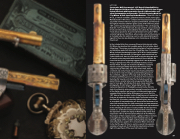
LOT 1103
Spectacular, Well-Documented, 1877 Dated, Deluxe Exhibition
Grade Engraved, Gold and Silver Plated Pair of Colt .22 Spur Trigger
Pocket Revolvers with Presentation Case, R.L. Wilson Letter, and
other Documentation as Pictured in “The Colt Engraving Book Vol.
I” by Wilson -A) Colt Open Top Pocket Revolver - Serial no. 1130, 22
RF cal., 2 7/8 inch round bbl., gold/silver/nitre blue finish, walnut grips.
Manufactured in 1877, this is a unique and truly spectacular pair of Colt
.22 pocket revolvers which are engraved, embellished, and finished to
the highest of deluxe exhibition grade quality, with both being dated
1877, and the pair being featured prominently in “The Colt Engraving
Book Vol. I”. On p. 359 of that book, the pair and their case are pictured
in full color where they are described by the author, R.L. Wilson, as the
“most deluxe specimens of each model known to the author.” While
certainly high praise from Wilson, who provides some further praise in
an included letter, his words may even be a bit underwhelming with
regards to these two jaw-dropping, iconic masterpieces of American
firearms art.
In the included letter from renowned firearms historian and author
R.L. Wilson, he describes this incredible works of art in further detail,
titling them “The unique cased and matched pair of custom engraved
and exhibition grade Colt Open Top .22 and New Line .22 revolvers”.
Wilson indicates that during the years 1873-1879, a limited number,
possibly only a few hundred, Colt handguns were embellished in a
“quite stylish scroll, done by a fine hand”, a style he states was quite
in contrast to that associated with the work of Cuno Helfricht. He
notes that the style of engraving suggests that it was by Gustave
Young, or perhaps one of his very talented students, such as
Herman Ulrich. Though not mentioned by Wilson, it certainly
remains a strong possibility that these two revolvers were
engraved by L.D. Nimschke at his shop in New York, with the
scrollwork and animal heads in particular showing similarities
to his work. He notes the elegant and intertwining nature of
the scrollwork, a signature of Young’s work and that of those
he influenced. Wilson goes on to note that all of the revolvers
featuring this “special scroll style” that he had observed had
plated finishes, usually nickel, and were generally fitted with
pearl or ivory grips. He indicates that upon closely examining
photographs of Colt’s famous “wheel display” at the 1876
Centennial Exposition in Philadelphia, one will notice that this
style of scrollwork is quite prevalent among the revolvers featured
in the display, a pattern we have also noticed examining previous
examples linked to the display. Wilson goes on to note that the
1877 date on these revolvers is also of significance, as it marked the
final year of production for both the Open Top Pocket revolver and
the New Line .22 revolver, potentially indicating they were crafted
as some kind of commemorative pair. He notes that he knows of no
other Colt revolvers from the 19th century that are commemorated
in such a way, making this set “quite remarkable and unprecedented
in the collecting of Colt arms.” It is also possible that this pair were
created as a celebration of Colt’s art that had been on display at
the exposition, possibly for display in Memorial Hall, which had
reopened in 1877 as the Pennsylvania Museum of Art. Whatever
the purpose of their original creation, a glimpse of these revolvers
is enough to be certain that they were intended to be an eye-
catching display of the incredible craftsmanship and artistry the
Colt company was capable of. In conclusion, Wilson notes that
he has had the good fortune to examine several truly exquisite
examples of cased sets of Colts and that is particular set ranks
high in the pantheon of fine cased Colt revolver sets.
97


