


Page 130 - 4096-BOOK2
P. 130
128
LOT 1135
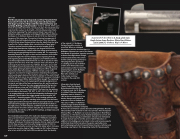
Well-Documented Factory Engraved and Silver Plated Colt First
Generation Frontier Six Shooter Single Action Army Revolver
with Eagle Carved Pearl Grips with Silver Mounted Holster and
Cartridge Belt Rig and Factory Letter - Serial no. 333106, 44-40 cal., 4
3/4 inch round bbl., silver finish, carved pearl grips. The included factory
letter lists this revolver in .44-40 with a 4 3/4 inch barrel, silver finish,
and factory engraving. The stocks were not listed. It was sold to J. H.
McAdams (address unavailable) and shipped to Blish, Mize, & Silliman
Hardware Co. in Atchison, Kansas, on July 22, 1916, in a shipment of
two guns of this same type. The revolver is featured on page xxvi of
“A Study of the Colt Single Action Army Revolver: Thirty Year Edition
1976-2006” and where the description notes the details from the letter
as well as the “unique, upside-down carved mother-of-pearl grips...”
The other revolver from this shipment was serial number 333116
sold by Rock Island Auction Company in our August 2022 Premier
Auction and lettered very similarly aside from being noted as having
Level 3 engraving and having the order number 380. The engraving is
essentially identical. The grips on that revolver features a carved steer
head on the right. The revolvers display classic engraving from the
Colt engraving shop under Master Engraver Cuno Helfricht and were
most likely engraved by Helfricht himself. It is safe to say that no other
engraver knew the lines of the 19th century’s most iconic firearm, the
Colt Single Action Army, better than Helfricht. During his tenure with
Colt, Helfricht saw the transition from percussion to cartridge firearms
and a rapidly growing market for engraved firearms. When engraved
firearms were their most popular, Helfricht oversaw a shop of six
engravers, but orders for engraved revolvers slowed by the early 20th
century, and experts believe that Helfricht did most of the work himself
with the help from one to two assistants. Helfricht’s successor’s included
famed Colt engravers Wilbur Glahn and William Gough. The engraving
includes panels of fine scroll engraving with beaded backgrounds on
the barrel, and sides of the frame and wavy line, dot, and line patterns
on the balance. The barrel has a star engraved ahead of the two-line
Hartford address on top and “COLT FRONTIER SIX SHOOTER .44-40”
with an engraved wavy border on the left. The frame has star patterns
on both sides at the breech, “PAT SEPT 19 1871./JULY 2 72 JAN. 19. 75.”
in an engraved banner on the left side followed by the Rampant Colt
trademark. The left side of the trigger guard has the triangular “VP”
proof and “1”. Assembly number “53” is on the loading gate and rear
of the frame on the right. The matching serial number is on the frame,
trigger guard, and back strap. The distinctive pearl grips feature a raised
relief spread wing eagle engraved with its head towards the butt on
the right panel, a smooth left panel, and blind screw. The double loop
holster features nine silver conchos along the top and scroll and eagle
head tooling. The belt has a “38” and “44” markings, cartridge loops, and
an ornate silver buckle.
An included document from John Clark states that the revolver and
silver accented holster rig were purchased in 1938 by his step-father
William J. Lippincott who owned the Wide Ruins Trading Post off of
Highway 66 between Chambers and Ganado, Arizona. Lippincott joined
the U.S. Navy and was sent home after being wounded in 1942. He
died in 1957 leaving the revolver and rig to his widow who in turn gave
them to her son John Clark in 1988. He sold it in 2001 to Ron Peterson
who in turn sold it to Rod Smith. With no address listed, the identity
of the original J. H. McAdams
that purchased the revolver is
unverified. When we cataloged
the previous revolver, we noted that J. H.
McAdams of Kansas was a part of the Kansas
State Board of Agriculture, a poultry specialist
at Kansas State Agricultural College,
and a livestock farmer. The current
revolver and rig having provenance
indicating they were purchased
at a trading post in the Southwest
and the silver finish and accents
point towards another noteworthy
potential buyer: Joel H. McAdams
(1879-1929), a former Rough
Rider who worked as an
Indian trader and silver
merchant in the early 20th
century.
Information from the book
“Navajo Trader” by Gladwell
Richardson detailing the life
of his great-uncle Joel H. McAdams
is included. Richardson indicates
McAdams came to Arizona in
1895 at the encouragement of his
brother George and worked for
at brother’s stores at Redlake and
Tuba City. In 1898, J. H. McAdams
and his younger brother Richard P.
“Pink” McAdams, enlisted in Company
H of the 1st U.S. Volunteer Cavalry (the famous Rough Riders). Records
indicated they both mustered in and out as privates. After the Spanish-
American War, J. H. McAdams ran various trading posts in New Mexico
and Arizona. In 1907, Don Lorenzo Hubbell attempted to run him off a
new post at Sunrise Springs, but McAdams refused to be intimidated.
A couple of years later, he sold the post to Hubert Richardson. In
addition to the trading posts, he traded in silver and turquoise jewelry
and trained silversmiths to produce the goods, reportedly at one
point employing nearly four thousand Native American craftsmen and
becoming a key figure in the burgeoning market for Navajo jewelry.
As pictured & described in A Study of the Colt
Single Action Army Revolver: Thirty Year Edition
(1976-2006) by Graham, Kopec & Moore

