


Page 172 - 4096-BOOK2
P. 172
170
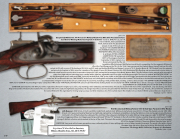
LOT 1178
Well-Documented Whitney Pattern 1853 Enfield Type Percussion Rifle-Musket
with Bayonet - NSN, 58 cal., 40 inch round bbl., bright finish, walnut stock. Whitney manufactured around 3,500 of these rifle-muskets around 1859-1862.
At least 2,000 were purchased by Maryland and primarily captured by Confederate sympathizers during the Baltimore riots, and Georgia received between
1,225 and 1,700 of them before the outbreak of the Civil War. It has a bayonet stud/blade front sight, Whitney’s long-range rear sight, “E. WHITNEY” marked
lock, brass trigger guard bow, iron trigger guard strap, and boxed “SR” over “15” stamped on the left stock flat. Includes a leather sling and socket bayonet. “GDM”
(George D. Moller) collection initials marked at the toe of the stock. This exact rifle-musket is pictured on pages 473 and 474 and the model is discussed on pages
472-476 in George D. Moller’s “American Military Shoulder Arms, Vol. III.”
CONDITION: Very good with a brown-gray patina, some scattered patches of minor pitting and a series of dings towards the muzzle. The wood is fine with a chip at
the upper tang and minor dings and scratches. Mechanically excellent.
Provenance: The George Moller Collection; Property of a Gentleman.
Estimate: 3,500 - 5,000
LOT 1177
Exceptional Whitworth .451 Percussion Military Match Prize Rifle with Presentation Case
Inscribed to Winning Marksman Captain A. G. Brown - Serial no. B486, 451 cal., 32 7/8
inch round bbl., blue/casehardened
finish, walnut stock. The presentation
plaque on top of the oak case is
inscribed: “1ST LANARKSHIRE RIFLE
VOLUNTEERS/3rd Western Company/
WHITWORTH RIFLE./Won by Captain
A. G. Brown./AT THE COMPANY
COMPETITION./7th September,
1861”. In The Glasgow Herald on
September 5, 1861, Captain A. G.
Brown announced that the 1st
Lanarkshire Rifle Volunteers (3rd Western) would hold a competition for the company’s Whitworth
rifle at the Possil Range on the 7th. On the 10th, it was announced that Captain Brown himself had won this rifle
valued at £25 with a score of 18 shooting at 200, 400, and 600 yards and besting McMillan and Granger’s scores of 14. A. Gordon Brown (b. 1827) helped form the regiment
and was elected captain in 1860, served as a member of the guard of honor for Queen Victoria at the 1860 Wimbledon Rifle Meeting, and was promoted to junior major in
1869 and retired from the service when he moved to Liverpool in 1870 and worked as manager of the North-Western Bank. The rifle features a brass ramrod guide, dovetailed
globe front sight with an interesting ivory crossbar with a sight line, adjustable notch rear sight, and folding peep sight. The barrel is marked “WHITWORTH PATENT” on
top and Birmingham proof marks and “B486” on the left at the breech. “486” is also visible on the right side of the trigger guard and inside the patchbox lid. The lock has the
crown and “W” trademark at the rear, “WHITWORTH” at the front, and a sliding half-cock safety at the front of the hammer. The stock has a checkered forend and wrist. The rifle is
accompanied by consignor research, the oak case, and variety of accessories, including a mold, powder flask, and sling, as well as three medals: “THE GRAND AGGREGATE WIMBLEDON
1884”, “H.F. O’CONNOR” inscribed King’s Trophy Competition NRA medal “FOR SPECIAL DISTINCTION”, and a medal with riflemen shaking hands over the motto “VIS UNITA FORTIOR” (force united is stronger) marked “PRESENTED/BY
THE/DOMINION OF CANADA/RIFLE ASSOCIATION/1868” on the back.
CONDITION: Extremely fine with 85% plus of the original blue finish, 50% original case colors, crisp markings, minor oxidation, and limited wear. The stock is excellent with most of the original finish, crisp checkering, and minor
dings and scratches. Mechanically excellent. The case is fine with some cracks, the right latch peg absent, and storage wear. The accessories are generally fine with minor wear mostly from age. Overall, a fine and historic example of
the iconic Whitworth rifle, legendary for its long range accuracy and often viewed as one of the earliest sniper rifles thanks to its use by both British and Confederate sharpshooters.
Estimate: 12,000 - 18,000
As pictured & described in American
Miliary Shoulder Arms, Vol. III by Moller


