


Page 209 - 4096-BOOK2
P. 209
LOT 1226
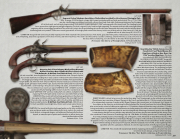
Engraved Cooley Takedown Smoothbore Flintlock Gun Inscribed for John Harvey of Finningley Park -
NSN, 16 gauge, 32 3/8 inch part octagon bbl., brown/casehardened/brass finish, walnut stock. This c. 1770s-1780s
gun has a multi-stage smoothbore barrel with a fancy silver blade front sight, Ordnance private proof on the upper
left at the breech, and a breech plug inscribed “JOHN HARVEY ESQR/FINNINGLEY PARK” and engraved at the breech end. The standing breech
has a grooved rear sight groove and light engraving. The lock is signed “Cooley” and has light engraving. The mounts are brass with some light foliate
engraving and an acorn trigger guard finial. The stock has a joint in the forend allowing the stock to be taken down with the barrel, and the wrist has broad
checkering and cross patterns. There were several generations at Finningley Park named John Harvey. In this case, it likely refers to John Harvey (d. 1793), the
nephew and heir of John Harvey III (1703-1771).
CONDITION: Very good with some old, possibly original, brown finish retained in the protected areas of the barrel, gray and brown patina on the balance of the barrel and
lock, mild pitting, attractively aged patina on the brass mounts, and mild overall wear. The stock is also fine and has scratches and dings, small worm holes, a crack at the nose of
the lock, distinct checkering, and a few divots on the butt. Mechanically functions.
Provenance: John Harvey of Finningley Park; A Private Collection.
Estimate: 3,500 - 5,500
LOT 1228
Very Attractive “British Colours Over All
French Forts” and “David Brewer, His
Rum Horn, at Quebec, Ano. Dom. Sep
1759” Inscribed Rum Horn - This horn
is inscribed with “BRITISH/COLOVRS/ON/
ALL/FRENCH/FORTS/AYE READY” along with
“DAVID BREWER/HIS RVM HORN/AT QVEBEECK
ANO./DOM. SEP 1759” and also features the
British coat of arms and an engraved French &
Indian War themed map. The engraving has light
polychroming color with red and black tint. The horn
measures approximately 6 1/2 inches long, 2 5/8
inches wide on the smaller end, and 3 1/2 inches at
the other end. The wide end has a small wooden plug,
and the pewter lined mouthpiece is not plugged. It is
accompanied by a rebound first edition of “Journals
of Major Robert Roberts” by Franklin Hough and a
framed handwritten note dated July 8th, 1893, that
states: “This horn belonged to David Brewer who
fought with the rangers during the French & Indian
uprisings. He was my great great grandfather.
Henry D. Hobson.” The back of the frame lists the
documents as belonging with “a powder horn of
greenish color with silver mountings marked ‘MAJ.
ROBERT ROGERS’ in block letters across the walnut base plug.” Fort Ticonderoga’s on-line collection notes state:
“David Brewer was a member of Rogers’ Rangers in the French and Indian War; in 1759, he served as the captain
of an independent company of rangers within Rogers’ Rangers after several years as a lieutenant. He is known to
have taken up the American cause during the Revolutionary War. He may have been the Colonel David Brewer
who served as the colonel of a Worcester regiment in 1775 and was dismissed from the army in October 1775 after
being convicted by a court-martial for misbehaviors including making his soldiers work on his farm and asking for
more blankets than his regiment needed. He was also charged with obtaining a lieutenant’s post for his son David
Jr. and claiming that his son was with the army when he was at home, but he was acquitted of this charge. They
also noted that he was “Present at Ticonderoga, July 6-8, 1758 (Battle of Carillon); present near Ticonderoga, March
6/7, 1759; probably present at Ticonderoga, July 23-August 4, 1759”. A footnote in “Early Western Travels, 1748-
1846” states: “Captain David Brewer joined Rogers’ Rangers as ensign in 1756, and three years later was promoted
for gallant services on Lake Champlain. He appears to have been one of the most trusted officers of this company.
Rogers left him to bring up the troops to Presqu’ Isle, while he hastened on to Fort Pitt, at the beginning of the
expedition after the capitulation of Detroit, he sent the larger portion of the Rangers back to Niagara
under Brewer’s command.”
CONDITION: Fine overall with exceptionally distinct engraving and inscriptions, attractive tint, some
very minor insect damage, and generally minor wear.
Provenance: The John “Tim” Breth Jr. Collection; A Private Collection.
Estimate: 3,000 - 5,000
LOT 1227
Attractive Pair of Revolutionary War Era Silver Mounted
Griffin & Tow Brass Barrel Flintlock Officer’s Pistols with
1778 Hallmarks -A) Griffin & Tow Flintlock Pistol - NSN, 65 cal., 9
1/4 inch round bbl., brass/bright/silver finish, relief carved walnut stock. This pair of pistol
has London hallmarks including the “c” date code for 1778 and “I-K” silversmith mark on
the trigger guard tangs which placed the production the middle of the partnership of
Joseph Griffin and John Tow from 1772 to 1782. The mounts include an acorn finial on the
trigger guard, grotesque mask pommel caps, classical martial trophy pattern escutcheons
inscribed with a crest featuring a bird, pierced scrolling side plates, and ramrod ferrules.
The smoothbore brass barrels are signed “GRIFFIN & TOW - LONDON” and have
London proofmarks flanking Griffin’s maker’s mark. The rounded locks are
signed “GRIFFIN/& TOW” and have sliding half-cock safeties and light border
engraving. The full-length walnut stocks have raised relief shell carving.
CONDITION: Fine overall with attractively aged patina on the silver and
brass, gray and brown patina and faint pitting on the lock, slight crack in
the cock, crisp carving and designs, split in the forend tip, and mild wear.
Mechanically functions. B) Griffin & Tow Flintlock Pistol - NSN, 65 cal., 9
1/4 inch round bbl., brass/bright/silver finish, relief carved walnut stock. As
described in “A”.
CONDITION: Fine overall with attractively aged patina on the silver and brass,
gray and brown patina and faint pitting on the lock, cracks in the cock and
stock, distinct carving and designs, and mild wear. Mechanically functions.
Overall, an attractive pair of pistols well-suited for an officer during the
American Revolutionary War.
Estimate: 3,500 - 5,500
207


