


Page 315 - 4096-BOOK2
P. 315
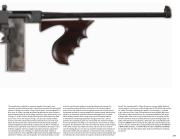
The specifications called for a maximum weight of 5 pounds, semi-
automatic operation (full automatic capacity not essential, but welcomed),
capable of being carried with a sling or other device, and chambered for a
then-new .30 caliber cartridge developed by Winchester. Auto-Ordnance
prepared two models for the resulting evaluation. One, which can be seen
on page 12 of “M1 Carbine: Design, Development & Production” by Ruth,
was a more or less new weapon using a one piece stock and a tubular
receiver, and while it had some promise it did not move on to the next
phase of testing. The other, represented here by this specific example
and photographed and described on pages 242 and 243 of “Thompson:
The American Legend” by Tracie Hill, was essentially the Thompson 1921
with the magazine well area lengthened and the internals adjusted to
accommodate the new cartridge. It is believed that Auto-Ordnance,
concerned that the new Light Rifle might render their flagship Thompson
obsolete for military sales, was hoping to show that their product could
meet the specifications without retraining infantry and armorers for
a new weapon and would allow continued use of already acquired
parts stocks, and unlike the other designs was based on a battle tested
mechanism instead of coming straight off a drawing board, which would
allow for an extremely rapid turnaround and deployment if accepted.
While military planners have a long track record of keeping logistics
in mind when considering equipment changes, there was a serious
problem; the resulting weapon was over double the maximum weight
for the specification, clocking in at 10 pounds, 5.3 ounces with an empty
magazine. The Thompson, one of the most famous “heavy metal” weapons
of the 20th century, was simply too heavy, and was not even allowed
into the testing phase to see if it was worth the weight. Total numbers of
this model of trials rifle are unknown; as the trial was only a preliminary
Ordnance test to determine the most essential mechanical suitability, with
no field trials, the total number of weapons needed would be extremely
limited. An unnumbered .30 caliber Thompson using a slightly different
receiver pattern can be seen on the facing page of Hill’s book, and another
.30 caliber Thompson following this pattern, serial number 1, is known
in the collection of the Cody Firearms Museum at the Buffalo Bill Center
of The West, and per museum lore it is reported that William “Bill” Ruger
of Ruger fame claimed to be personally involved in its assembly during
his time with Auto-Ordnance. Blade front and Lyman folding ladder rear
sights, with the former installed on a distinctive, thin and unfluted barrel
marked “CARBINE 30 M1” inverted on the right side, and the latter on the
receiver, which is marked “No.2” and partially hand-stamped “THOMPSON
SUBMACHINE GUN/CAL. 30 SHORT RIFLE M1/SELF-LOADING CARTRIDGE”
on the right side; the other typical Auto-Ordnance/Thompson markings
are absent.
313


