


Page 336 - 4096-BOOK2
P. 336
Throughout the war, the British “ULTRA” team at Bletchley
Park continued work on breaking and re-breaking the codes
as they evolved and changed throughout World War II utilizing
mistakes by German operators such as the repeating of words
or phrases to decipher the coding. Alan Turing remains the best
known of the Bletchley code breakers and was key in developing
“bombes”, machines that could run through hundreds of
possible Enigma settings simultaneously to calculate the Enigma
key settings, but the overall operation was truly a team effort
building on the foundational work of the Polish mathematicians.
American teams in Washington, D.C., and Dayton, Ohio, also
worked diligently to decipher Enigma messages.
The already monumental task was further complicated by
the Kreigsmarine adopting three additional rotor options
and stricter operations controls, but in 1941, the Royal Navy
captured a complete Enigma with all eight rotors and the current
codebook from a German vessel without the Kreigsmarine
knowing. A new version of the Enigma machine that allowed a
thin fourth rotor to be installed was adopted in early 1942 added
further complexity and temporarily stonewalled the Bletchley
team’s ability to read Kreigsmarine intercepts until U-559 was
captured with its Enigma and codebooks on October 20, 1942,
allowing the team of brilliant men and women at Bletchley Park
to continue to contribute vital intelligence for the Allied
war effort.
The contributions of intelligence captured through breaking
the Enigma codes is difficult to overstate and also to
calculate. While German operations early in the war were heavily
aided by Enigma messages, the successful Allied breakthrough
played a role in the defeat of the Axis powers. So called “ULTRA”
intelligence is widely credited with significantly speeding up
Allied victory and potentially saving millions of lives in the
process. The Allies were able to use intercepted
intelligence to deliver victory on the battlefield,
prepare for planned enemy attacks, plot their own
operations with advanced knowledge of enemy
positions, and carefully maneuver convoys around
wolfpacks at sea.
However, the Allies had to be cautious not
to give away that they had broken through
Enigma in order to continue to utilize the
intelligence. The Germans had to remain confident
their messages were secure otherwise they would
adapt and the valuable stream of intelligence
would be cut off. To keep the German leaders in
the shadows, sometimes potential targets, such as
German ships, would be allowed to escape, or they
also would be “discovered” by an alternate means
such as Allied ships or planes “scouting” the area. Another
option was sending counter-intelligence to deceive the Germans
into believing that Allied intelligence concerning German
operations was sourced from non-existent spies adding both
cover for the true source and paranoia. The successful cracking
of the Engima machine remained a closely guarded secret for
many years. It was not until the mid-1970s that the United
Kingdom began to declassify records relating to the program,
and they did not become fully known until the 1990s.
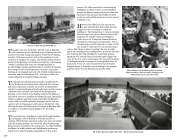
German U-Boat during World War II
Heinz Guderian in the Battle of France with an
Enigma machine. Note one soldier is keying in text
while another writes down the results.
The D-Day Operation of June 6th, 1944 - The Invasion of Normandy
334


