


Page 334 - 4096-BOOK2
P. 334
The Enigma Machine
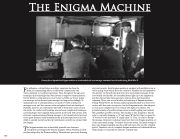
German forces depended on Enigma machines to encode and decode secret messages transmitted over the radio during World War II.
For millennia, a critical factor in military operations has been the
ability for commanding officers to effectively communicate with
various elements to coordinate operations. Thus, throughout the ages, new
techniques and technologies had been devised to improve communications,
but the ability to communicate to your troops is of little use if your enemy
can intercept and understand your messages and respond accordingly. To
make proper use of communications, you need to be able to keep your
messages secret, and thus various codes and ciphers have been developed.
Naturally, however, your adversaries will work to break your codes to learn
the secrets. To combat code breaking, new and more complicated techniques
and technologies were regularly being created. In the early 20th century, with
electronic communications allowing messages to be transmitted and received
across great distances nearly instantaneously, and intercepted just as fast, the
ability to quickly encrypt and decrypt information securely was critical. Enter
the Enigma.
The Enigma machine was an incredibly powerful new electronic
encryption tool designed by German engineer Arthur Scherbius in 1918
and later adopted by the German military. The machines operate by diverting
electrical currents. Each Enigma machine is equipped with multiple rotors as
well as a plug board which divert the current to scramble the text inputted by
the operator on the keyboard and turn it into an encrypted message. In the
most widely used models, the scrambled letters light up on the lampboard,
and then the encrypted message can be written down and transmitted
separately. There were several models and variations of Enigma machines.
During World War II, the German military primarily relied on a three-rotor
version with five total rotor options, but the Kreigsmarine also later adopted
an even more complex four-rotor version with eight rotor options. The
potential number of possible settings creates a mind boggling one hundred
fifty quintillion possible solutions. The machine is also designed so that the
code is constantly changing, so “A” may equal “B” the first time you press the
“A” button, but the next time “A” might equal “X”. Thus, in order to decrypt
the message, the person receiving it must have their own Enigma machine set
to the same initial settings. To further secure the system, the initial settings or
keys were changed regularly, and the codebooks were only used for a limited
period. Therefore, even if a complete Enigma machine and codebook fell into
Allied hands, it would only be useful for a limited time.
332


