


Page 126 - 4096-FLIPBOOK3
P. 126
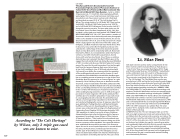
LOT 3188
Ultra Rare and Historic Documented Colonel Colt
Presentation Triple Cased Set of Percussion Revolvers to
Samuel Colt’s Close Friend and Best Man Lieutenant Silas
Bent -A) Colt Model 1851 Navy Revolver - Serial no. 49962,
36 percussion cal., 7 1/2 inch bbl., blue/casehardened finish,
walnut grips. This is one of only two known Colt triple cased
presentation sets of percussion revolvers and is illustrated
and described on pages 52-53 of “The Colt Heritage” by R.L.
Wilson. The casing consists of a Colt Model 1851 Navy revolver
(sn# 49962), Colt Model 1849 Pocket revolver (sn# 149376),
and a Colt Model 1855 Sidehammer Pocket revolver (sn# 441)
along with several accessories. The brass plate in the case lid
is inscribed: “Lieut. Silas Bent/Compliments of/Col. Colt”. Also
included is a false hard cover book marked “LIEUTENANT/SILAS
BENT/COMPLIMENTS/OF COL. COLT” that contains a number of
documents related to their relationship and some photographs
of the set. As detailed in several of the documents, the set was
discovered in the 1930s in St. Louis in the possession of a major,
which is logical given it was the home of his wife’s estate, his
birthplace, and Bent would have had many friends there. After
its discovery, it was sold to Norm Flayderman and was in his
collection for a while. Many of the other documents provide
details on Silas Bent and his relationship with Colt. Noted Colt
historian R.L. Wilson, in an included letter, writes that “Samuel
Colt was a man with innumerable acquaintances, but, by
choice, with very few close friends. One of these, as evidence
demonstrates, was Lieutenant Silas Bent.” Wilson goes on the
suggest that Colt and Bent had met during the Great Exhibition
of 1851 in London and discusses that Bent helped Colt acquire
many of the arms that he and Commodore Perry had brought
back from the Japanese Emperor. Bent served as best man
at Sam Colt’s wedding in June of 1856 and rode ahead with
Colt several hours before the ceremony while the remainder
of the wedding party and guests went by steamer. It is well
recorded that Colt exhibited the sheathed kris that Bent gave
him as a wedding present at Armsmear as a sign of their close
friendship. Bent also appeared as an “honored guest” at a gala
thrown by Colt in February of that year as detailed in another
document, and an included letter from Bent addressed to “My
dear Colt” indicates that Bent helped Colt in his personal affairs;
in this case handling furniture for his estate. Bent was an officer
in the U.S. Navy with twenty years of experience by the time
of the wedding having started his career in 1836 at the age of
just sixteen. He later resigned in 1861 at the outbreak of the
Civil War due to his Southern sympathies. He was well versed
in oceanography and well connected. He advised American
officials concerning potential expeditions to the North Pole
and conducted hydrographic surveys of Japanese waters that
were published in “Sailing Directions and Nautical Remarks:
by Officers of the Late U.S. Naval Expedition to Japan”. Those
surveys were conducted while serving as the flag lieutenant of
Commodore Perry’s flagship USS Mississippi during the 1852-
1854 expedition to Japan to secure the release of eighteen
shipwrecked American sailors held prisoner by the Japanese
government. According to James Fallows in “After Centuries
of Japanese Isolation…”, Bent readied his outnumbered men
for hand to hand combat with the Japanese during one of the
intense encounters of the expedition. Once peaceful relations
were established, Bent worked to promote Colt’s firearms in
Japan. His service record is quite impressive; he crossed Atlantic
five times, the Pacific twice, rounded Cape Horn four times
and the Cape of Good Hope once. The mahogany case has
a brass inscription plate inlaid in the lid and a shield-shaped
brass escutcheon surrounding the key hole. The case is lined
with dark red velvet and has twelve compartments for the
three revolvers and the included American Flask & Cap Co.
“Coat of Arms” Navy size powder flask (Rapley #F30), “Eagle
and Shield” powder flask, two “COLTS/PATENT” marked bullet
molds, combination tools, 250 count tin of Eley percussion
caps, and American Flask and Cap Co. empty paper carton.
The accessories are pictured in the illustration of the case
in “The Colt Heritage”. The Third Model Navy revolver was
manufactured c.1856 and has the has the small rounded trigger
guard, loading lever screws that enter from the left side, thick
barrel lug, beveled loading cut-out, and “piano” finished grip.
It has the standard markings including the “-ADDRESS SAML
COLT NEW-YORK CITY-” barrel address and the matching serial
numbers. The Model 1849 Pocket revolver was manufactured c.
1858 and has the standard markings including the “{ADDRESS
SAML COLT/ NEW YORK CITY}” barrel address and matching full
and partial serial numbers. It also has a “piano” finished grip.
The Model 3A Sidehammer revolver was manufactured c. 1860
and is roll-stamped with the second style legend with Maltese
crosses but no hand on the top of the barrel and “PATENTED
SEPT. 10th 1860” stamped in one cylinder flute. The serial
number “441” is stamped on the underside of the barrel and
bottom of the back strap.
CONDITION: Very fine. The rare mahogany triple case is fine
with some light compression marks and scattered stains that
are hidden when the revolvers and accessories are in place. The
Navy revolver is very fine and retains 60% of the original finish
and 90% of the dove-gray case colors. Most of the blue finish
on the barrel and cylinder has aged to a smooth, gray patina
and considerable high polish blue finish is present in protected
areas. The naval scene remains almost entirely crisp and
complete. The percussion nipples have minimal flash pitting.
85% of the silver-plated finish is present on the trigger guard
and back strap. The grip is excellent with minimal handling
wear. Mechanically functions.
According to "The Colt Heritage"
by Wilson, only 2 triple gun cased
sets are known to exist.
Lt. Silas Bent
124

