


Page 267 - 4096-FLIPBOOK3
P. 267
265
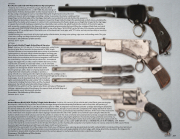
LOT 3440
Rare Joseph Schulhof Toggle Action Manual Repeater
Pistol - Serial no. 36, 10.5 mm cal., 6 1/4 inch octagon bbl., nickel finish,
hardwood grips. Based around a design patented in 1884, Joseph
Schulhof is known to have experimented with a variety of mechanisms
and magazines in his work, which included handguns and long guns.
This particular Schulhof Manual Repeater is built around a toggle link
driven bolt action mechanism and an internal magazine, both of which
are controlled by a ring lever that rests just ahead of a conventional
trigger. The toggle links are fully contained within the frame, so that
only the bolt and striker are externally visible; a set of removable
sideplates, the left signed “Pat. Schulhof”, enclose the mechanism. The
magazine runs through the bottom of the frame down
into the gripstraps, with a fixed set of spring-loaded teeth
along the bottom retaining the cartridges in position, a
group of teeth on a moving arm in the right side advancing the cartridges as the
ring lever is returned to the rear position, and the hinged left grip panel acting as a
loading gate. A set of dovetailed blade front and notch rear
sights are installed, with the serial number “36” on multiple
components including the barrel, frame and the checkered
grip panels, the left with externally visible hinge hardware.
CONDITION: Fine, with 60% of the original nickel finish, with areas of flaking and
rubbing, a gray patina and mild spotting on the exposed steel, and mild dings and
handling marks overall. Mechanically excellent.
Provenance: The Collection of Clive Cussler.
Estimate: 6,000 - 9,000
LOT 3441
German Mauser Model 1878 “Zig-Zag” Single Action Revolver - Serial no. 32, 9 mm cal., 6 inch solid rib bbl., nickel finish, gutta percha grips.
Developed in 1878, the Zig-Zag revolver was the first handgun designed and developed by Paul Mauser and his firm, while still operating in
partnership with Wilhelm Mauser as the Mauser Brothers (prior to 1884). A competitor to be the first centerfire cartridge-fed handgun adopted by
the German military, the 1878 scored high marks in overall performance, though concerns about the complexity of the design led them to choose
the 1879 Reichsrevolver instead. A number are believed to have seen service as privately purchased military sidearms. At the heart of the mechanism
is the combination of an angular track (the titular ‘Zig-Zag’) machined into the side of the cylinder and a toothed reciprocating bar linked to the
hammer, which serves to both advance and lock the cylinder, in contrast to the more commonly seen pawl/sprocket and stop arrangement. Additionally,
the spring responsible for resetting the cocking bar also powers the hammer, replacing the grip frame mounted leaf spring commonly seen in that era.
For loading, the barrel assembly is hinged at the rear of the top strap, automatically pushing the hammer back to the safety notch when opened, with the
closure latch doubling as the lever for a star-pattern extractor assembly. Sights are fixed, with “GEBR. MAUSER & Cie OBERNDORF a/N. WURTTEMBERG. 1878. PATENT.”
on top of the barrel rib, “crown/crown/U” on the left side of the barrel, and the matching full and partial serial number marked on various components. With a pair of finely
decorated gutta percha grip panels with swan and dragon motifs and scroll accents.
CONDITION: Fine overall, with 60% of the original nickel finish, areas of flaking or wear exposing gray patinated steel with scattered light to moderate pitting, most prominent
on the right side of the barrel and topstrap. Grips are oversized replacements, overhanging slightly at the front edges, with strong detail in the decoration. The hinge pin for
the hammer is absent, which interferes with operation; the revolver appears to mechanically function when a substitute is inserted.
Provenance: The Collection of Clive Cussler.
Estimate: 2,750 - 4,250
LOT 3439
Rare Passler and Seidl 1887 Patent Manual Repeating Pistol
- Serial no. 40, 7.7 mm cal., 5 3/4 inch octagon bbl., blue finish,
walnut grips. Patented in the U.S. c. 1887-1888, the pistol design of
Franz Passler of Vienna shows parallels to other manual repeaters of
the day, using a ring trigger to cycle a round bolt, flicking the ring forward to retract the bolt
and back to close it, with a bar trigger controlling a striker; in operation, the shooter could keep their
trigger finger on the front edge of the ring trigger during the rearward pull to cock and chamber the weapon to
be discharged at leisure like a single action weapon, or keep their finger inside the ring to fire automatically on bolt closure, emulating the
speed of fire of a double action weapon. In contrast to it’s contemporaries, the Passler design uses a straight bar integral to the ring trigger
to operate the bolt, with feeding accomplished via a Mannlicher-style en-bloc clip, which feeds into the bottom of the short magazine
well, secured by a spring catch in the frame with a spring-loaded swing arm under the barrel lifting the cartridges. Blade front and notch
rear sights, with “WELT/PATENT/PASSLER & SEIDL/WEIN” on top of the frame, “GUSS-STAHL” on the left side of the chamber, and matching
serial number “40” on multiple parts. Fitted with a pair of checkered bird’s head grips, with “72” in blue and red paint (possibly an inventory
number) on the butt.
CONDITION: Very fine overall, with 95% plus high quality refinished blue, showing minor pitting, edge wear and handling marks. The grips
show some scuffing and dings. Mechanically functions.
Provenance: The Collection of Clive Cussler.
Estimate: 6,500 - 9,500


