


Page 204 - 4096-BOOK2
P. 204
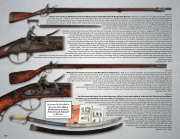
LOT 1216
Fine Documented Virginia Silver Hilted American Officer’s Sword with Scabbard, as Described in “American Silver-Hilted,
Revolutionary and Early Federal Swords Volume II” by Hartzler - Manufactured during the earliest phases of the life of the United
States of America, this sword is described on page 438 of the book “American Silver-Hilted, Revolutionary and Early Federal Swords,
Volume II” by Daniel Hartzler, as part of the chapter on swords originating from Virginia. The description in the book notes
the sword as having a one-piece silver pommel rendered as “lion... with bruin features and leaf-design
ears”, additionally noting the decorated guard and ivory grip. Overall length is 33 1/2 inches
with a 28 1/4 inch single fuller blade with a flat spine, niter blue panels on the lower half, and
subtle floral themed decoration. The guard is silver, connected to the pommel with a chain
guard with pierced-through branches and engraving on the top and bottom, a smooth ivory
grip with a narrow silver band wound around the length, and the aforementioned pommel.
Included with the lot is a black leather scabbard with silver throat
and top, and a copy of the aforementioned book by Hartzler.
CONDITION: Fine overall, with minor spotting on the bright portions
of the blade, much of the original niter blue, well-aged silver, and
some age cracks in the grip. The scabbard tip shows some dents
and seam splits, and the leather has mild scuffing.
Estimate: 4,500 - 6,500
LOT 1214
Historic “US” Surcharge Marked Revolutionary War Era French Charleville Flintlock Musket with Bayonet - NSN, 69 cal., 44 3/4 inch round bbl., brown finish, walnut
stock. Manufactured c. 1760s to early 1780s. French Charleville muskets were among the most widely used firearms of the American Revolutionary War for the Patriots fighting
under General George Washington in the Continental Army as well as the various militias. Muskets and components were imported in large numbers from our French allies who
also used them in combat in North America. After independence was secured, these muskets became the primary arms of the United States Army and provided the basis for our
own domestically produced muskets. They continued to see use in conflicts on the frontier as well
as during the War of 1812 when we again fought against the British to secure our freedom and
honor. The lock has a “*/D” inspection mark just behind the faceted priming pan and is inscribed
“Charleville” at the center, and the tail of the lock has a “US” surcharge mark that measures approximately 5/16 inches in height, with “I.B.I” on the interior of
the lock. The initials “IN” are stamped on the concealed rear surface of the buttstock, the stamping of prolific Continental Armorer John Nicholson. Per the
article “United States Surcharges: Continental Ownership of Arms and Accoutrements” from the American Society of Arms Collectors Bulletin 87,
author Rex Kessler states, “After the Revolution, there was prolific stamping of muskets stored in the armories. These included new French muskets,
repaired muskets and re-repaired muskets. These stamps are post-Revolutionary surcharges stamped by Continental armorers on existing locks
and barrels of muskets and bayonets. The muskets are identified by surcharges on the barrel and lock, and a small inspector’s mark branded on the
stock, usually behind the trigger guard or adjacent to the side plate. John Nicholson, a continental armourer, brands some muskets on the stock or
behind the butt plate with the initials (IN).” Initials “JC” are stamped on the interior of the buttplate. The barrel has a rectangular iron bayonet lug
on top set back 1 inch from the muzzle, a partial “*/D” inspection mark on top towards the breech, with no other visible exterior barrel markings.
A brass blade front sight is on the rear strap of the upper barrel band, and all three bands are secured with springs as used on the Model 1766.
Sling swivels mounted in front of the trigger guard and on the middle barrel band. A “P” is stamped on the inside of the trigger guard bow. Period
Continental armory type stock and ramrod. Includes a knife blade socket bayonet marked with some illegible inspection stamps and the number “750”.
CONDITION: Good, with antiqued brown patina, oxidation, characteristic wear, and legible lock markings and “US” surcharge. Stock is also good as restored, with cracks and chips, loose rear
band with partial retaining spring, and remains sound with nice figure. Mechanically functions. Bayonet is also good. This is a desirable example of a “US” surcharged Revolutionary War era French
Charleville musket!
Estimate: 4,000 - 6,000
LOT 1215
“Militarized” Colonial Era American Club Butt Flintlock Fowling Piece - NSN, 72 cal., 42 inch round bbl., unknown finish, cherry stock. The stock
of this gun has the distinctive “club butt” profile popular in the northern colonies during the colonial era. Many fowling pieces were “militarized”
during the French & Indian War and American Revolutionary War by cutting back stocks and installing lugs so that they could mount a bayonet
and be used for militia service. The only identifying marking on the gun is what appears to be “Archer” signed on the later replacement English lock
(late 18th century). The barrel has a bayonet lug on top and a grooved tang. The furniture is brass and has some foliate and border designs. The old
homemade hickory ramrod has a swollen head. The trigger guard finial has an old “81.1.36” inventory marking.
CONDITION: Fair overall with a well-used appearance, dark brown patina and moderate pitting on the lock and barrel, some
replacement parts on the lock, dark aged patina on the brass mounts, and moderate to heavy wear, including some chips and cracks in
the mounts and stock, including the buttplate worn through at the heel and reinforced by nails. Mechanically functions.
Estimate: 2,500 - 3,750
As pictured & described in
American Silver-Hilted,
Revolutionary and Early
Federal Swords Volume II
by Hartzler
202


