


Page 236 - 4096-FLIPBOOK3
P. 236
234
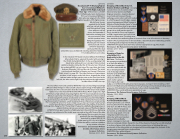
LOT 3372
Documented P-51 Mustang Fighter
Ace 1st Lieutenant William H.
Allen’s B-15A Flight Jacket and
Visor Cap - Offered here is a USAAF
B-15A flight jacket worn by American
P-51 ace 1st Lieutenant William H.
Allen who was assigned to the 343rd
Fighter Squadron, 55th Fighter Group,
8th Air Force. He was
awarded the Air Medal
with four oak leaf clusters
and Distinguished Flying
Cross with one oak leaf
cluster. On September 5,
1944, while returning from
an escort mission, Allen
and his squadron mates
flying the legendary P-51
Mustang ran into sixteen
German aircraft over an
airfield in Goppingen,
Germany. When the dust
settled Allen was credited with shooting down five Heinkel He
111s, making him an ace in a day.
In the included 1997 dated notarized affidavit from William
Allen attests that he acquired the jacket while serving in
the USAAF during World War II. In the accompanying 1998
dated letter addressed to our consignor Allen provided
additional details, stating that the B-15A jacket was “obtained
by me during WWII. I am not sure of the exact date, but it was
between November 1944 and the end of the war.” The jacket
is pictured and identified in Maguire and Conway’s “American
Flight Jackets” on page 255. The jacket features a Conmar zipper
and faint USAAF insignia on the left sleeve. Originally the jacket
had two leather triangle patches sewn to the chest: one on the
left side, the other on the right. Only the patch on the right remains.
Includes Allen’s USAAF visor cap.
Personal effects worn and carried by World War II aces are becoming increasingly
difficult to find. Perhaps no other aircraft conjures up the image of the fighter pilot
better than the P-51. It was the lame duck that evolved into America’s most capable
fighter once it was mated with the British Rolls-Royce Merlin engine. As a high
performance, high altitude, long range fighter, the P-51 was invaluable to securing
Allied air superiority in the European Theater. Mustang pilots have been credited
for destroying 4,950 German aircraft, which is more than any other Allied fighter.
Perhaps the best praise for the P-51 came from the 1944 report by the Truman Senate
War Investigating Committee, which stated the P-51 was “the most aerodynamically
perfect pursuit plane in existence.” They didn’t call it the Cadillac of the Sky for
nothing! Allen, flying his P-51 “Pretty Patty II,” helped to solidify the Mustang’s place in
aviation history, and now you can own a piece of that heroic legacy.
CONDITION: Very good overall as a flight jacket worn by an 8th AF ace, displaying
authentic use with most of the visible wear near and on the cuffs. Traces of the data
label remain. The visor cap is also very
good with the sweat band partially
detached. An original WWII B-15A
jacket worn by P-51 ace 1st Lt. William
H. Allen that will be a welcome addition
to any aviation collection.
Provenance: 1st Lieutenant William
H. Allen; The Putnam Green/
Sycamore Collection.
Estimate: 5,000 - 8,000
LOT 3375
Grouping of World War II
U.S. Aviation Memorabilia -
Grouping includes a pair of NCO
chevrons, three Air Force Patches
(one “star”, one 8th Air Force, and
a Russian Shuttle “winged red
star” patch), an embroidered cloth
Air Crew wings patch, “U.S.” and
“winged propeller” pins, and a
ribbon bar with Good Conduct,
European-African-Middle
Eastern Campaign (x1 star) and
American Campaign ribbons. Except for one of the chevrons, the patches are still attached
to sections of green cloth, and the other chevron retains traces of stitching that are a
good match to the other; while not documented, this would suggest the contents of the
grouping were removed from a single uniform.
CONDITION: Fine, with mild wear.
Provenance: The Putnam Green/Sycamore Collection.
Estimate: 1,500 - 2,500
LOT 3374
Grouping of Items for
a World War II U.S.
Bombardier in the 8th
Air Force - The items in
the grouping are attributed
to an Earle Rae Wilde, a
World War II bombardier
and officer with the 8th Air
Force. Grouping includes
a set of dog tags and an
Army Air Corps ID booklet
made out to Wilde, a fuse
safety pin, 8th Air Force
patch, leather captain
rank insignia, brass cap
badge, a set of five bomb sight ground speed gauges, and paper items including a 1923
dated 20,000 Mark note and 1943 Western Flying Training Command extract listing recent
graduates of the Army Air Force Bombardier School, which includes Wilde.
CONDITION: Fine overall, with wear appropriate to age.
Provenance: The Putnam Green/Sycamore Collection.
Estimate: 1,500 - 2,500
LOT 3373
Grouping of World War II Era U.S.
Aviation Artifacts and Wings - Grouping
includes three sets of aviation wings
(Aircrew, Aerial Gunner and Flight
Engineer variants), a crewman physical
record card and European Theater
exchange service ration card both marked
to a Staff Sergeant Lloyd Hodges, oxygen
system training manual titled “Survival at
Altitude of Heavy Bomber Crews”, a “blood
chit” style instruction sheet for grounded
aircrew interacting with Russian-speaking
groups, three cloth patches (one Air
Force, one 8th Air Force, one Engineer),
an ESM/1 signal mirror, and a set of four
bomb fuse safety wires. The safety wires
have attached notes attributing them as souvenirs from a set of bomb runs on Germany
in April 1945, in particular hits on two “jet fields”, a dynamite factory in Duneberg, and the
marshaling yards (and general vicinity) at Landschut.
CONDITION: The paper items show wear and tear appropriate to age, fine overall.
Provenance: The Putnam Green/Sycamore Collection.
Estimate: 2,000 - 3,000

