


Page 235 - 4096-FLIPBOOK3
P. 235
233
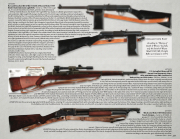
LOT 3371
Winchester Model 1897 Slide Action
Trench Shotgun - Serial no. E712285, 12
gauge, 20 1/4 inch round bbl., blue finish,
walnut stock. Manufactured in 1919 by Winchester as a trench
shotgun. Single brass bead sight on the 1918 patent dated
bayonet lug, original six-hole heat shield marked “PAT. JAN. 15 & MAR. 19,
1918” and barrel marked for cylinder choke. No American military markings are
present. 18-groove forearm, smooth pistol grip stock, checkered Winchester buttplate and “1918” dated leather sling.
CONDITION: Very fine, with 75% plus original blue finish, showing areas of brown patina, bright edge wear, driver marks on the screws, dents and scratches concentrated on the heat
shield, and mild handling marks. A thin scuff is present on the right side of the barrel, along with discoloration just below the heat shield. The wood is also very fine, with a few light
scratches and dings, and attractive grain. Mechanically excellent.
Estimate: 4,000 - 6,000
LOT 3370
U.S. Springfield Armory M1D
Garand Semi-Automatic Sniper
Rifle with M84 Scope, CMP Certificate of
Authenticity, and FOIA Letter - Serial no. 3819391, 30-06
Springfield cal., 24 inch round bbl., parkerized finish, walnut stock. Receiver originally manufactured
in July 1942 and subsequently arsenal upgraded to the M1D sniper specifications, with many rifles so
converted used during the Korean and the Vietnam Wars. Features fixed winged blade front and T105 adjustable
peep rear sights, wide base gas cylinder with a T37 pronged flash hider cylinder lock, “P P O” marked cross-slot lock screw, arsenal
replacement “S-A-10-52” marked M1D barrel with bright chamber ring, relief-cut “-9 SA” operating rod, “-12SA/S-06” bolt, “11” follower, along with a post-war “SA”
trigger housing with “SA” hammer, “SA-11” safety, and stamped trigger guard. The serial number is off-centered to the left on the receiver heel, an armory error. Fitted with a pair
of walnut handguards and a walnut stock with a “P” firing proof on the pistol grip, faint “RRA” stamp on the right of the wrist, “1117” inventory number stamped on the right of the butt,
and “MRT/MAY 1976” marked USGI leather cheek rest laced to the butt. Topped off with a M84 scope (post-and-cross hair reticle, serial number “29777”) with sun shade and rubber eye piece on a
M1D optic thumb- screw mount. Includes a M1907 pattern leather sling, a matching numbered Civilian Marksmanship Program (CMP) certificate of authenticity dated March 13, 2011, identifying the rifle as “M1D Garand”, as well
as a June 1, 2011, dated Freedom of Information Act (FOIA) request response letter from the U.S. Redstone Arsenal showing the rifle as received by the U.S. Army Tank-Automotive and Armaments Command (TACOM) Rock Island
warehouse at Anniston, Alabama, from a Greek shipment on July 10, 2008, and then transferred from the TACOM Rock Island warehousing to the CMP on December 9, 2008.
CONDITION: Very fine as arsenal upgraded to M1D specifications, retaining 95% arsenal parkerized finish with some light edge wear, minor cycling wear, the balance of the trigger housing a smooth brown patina, light spotting on
the buttplate, and minor handling marks. The sanded, re-oiled stock is also very fine with some light compression and handling marks. Mechanically excellent. The scope is excellent with clear optics.
Estimate: 3,000 - 5,000
LOT 3369
Rare and Excellent World War II Smith & Wesson Model 1940
Mark II Semi-Automatic Light Rifle - Serial no. 1696, 9 mm Luger
cal., 9 1/2 inch fluted bbl., blue finish, synthetic stock. Developed
c. 1939 by Smith & Wesson, the Model 1940 “Light Rifle” was based on a British government request for a
semi-automatic, light-weight rifle design chambered for the 9 mm Luger cartridge, and was tested against
the M1 Carbine by the U.S. as a pistol substitute for officers and support personnel. Despite some promising
features, the Mark I versions of the rifle were passed over by the U.S. and failed in British testing due to cracked
receivers caused by higher pressures generated by British military 9 mm Luger loads. Smith & Wesson revised the
Mark I design, resulting in the Mark II that integrated a machined ribbed steel collar mounted around the receiver,
which acted as a reinforcement as well as a positive bolt-blocking safety. This was not enough to save the project, and
the British shelved the Light Rifle, demanded a refund on their advance and, once the pressing matter of World War
II was resolved, cut up their stock of unwanted Light Rifles with a blowtorch and tossed the resulting scrap into the
English Channel, making such examples rare today. According to Smith & Wesson historian Roy Jinks, a number of
crated Model 1940 Light Rifles (137 Mark I rifles and 80 Mark II rifles) were found by Smith & Wesson in 1974 and subsequently
liquidated as curios with explicit instructions that they were not to be loaded or fired as detailed on page 240 of “The
History of Smith & Wesson” by Jinks. Features a fixed blade front sight, knob adjustable notch
rear sight (graduated from 200 to 400 yards), ribbed safety collar around
the receiver, a right side mounted reciprocating charging handle,
and novel magazine housing that holds the magazine, provides a
downward facing casing ejection chute at the rear, and acts as a
fore-grip for the user. Fitted with a black synthetic buttstock with
ribbed blued buttplate marked with a matching serial number.
Includes a leather sling.
CONDITION: Excellent, retaining 90% plus original blue finish
with some minor edge wear, a few light scrapes on the left of the
magazine housing, and a few light handling marks. The stock is very
fine with a crack running through the wrist. Mechanically excellent.
Estimate: 5,000 - 8,000
Collector’s Fact
According to "History of
Smith & Wesson" by Jinks,
only 80 Smith & Wesson
Model 1940 Mk. II Light
Rifles were found in 1974.


